Loglines
Launching a weekly all-company newsletter that unified Paramount's fragmented internal communications — and became the connective tissue of the cross-platform content engine.
Creating a content experience tailored to a key audience.
At Paramount, employees were considered an important audience in our global marketing efforts, but the internal communications landscape wasn’t tailored to their needs.
I pitched the idea of Loglines: a single, well-edited weekly newsletter that could consolidate the noise, serve the audience rather than the sender, and function as something more than an internal comms tool — it could be the internal distribution layer of a broader content strategy, connecting the newsroom, social, and employee communications into a unified storytelling engine.

The strategic premise of Loglines was the same premise that drove the entire Paramount content operation: know your audience, understand what they need, and deliver it in a form that respects their time and attention. For 35-40K employees spread across every brand and business unit — from Nickelodeon to CBS News to Pluto TV to Simon & Schuster — that meant a newsletter with a recognizable brand, a clear editorial structure, a consistent voice, and content that prioritized what employees actually wanted to know over what the company wanted to say.
I designed the content architecture from scratch: a Big Story section that covered one thematic topic per week based on subject rather than company division, a Screening Room spotlighting new content across platforms, a Good Housekeeping section for practical employee information, and a Headlines section aggregating press hits from across the company.
Each section had a defined purpose and a defined audience logic. Stories from the newsroom were packaged and distributed through Loglines; Loglines content fed back into social. The same story, told differently for each audience — the integrated cross-platform publishing model in practice.
My team ran a rigorous monthly analytics framework alongside the editorial operation, tracking open rates, click behavior, section-level engagement, and read time, and running send-time and subject-line experiments to continuously optimize performance.
We treated Loglines as an external editorial product, not an internal comms vehicle.
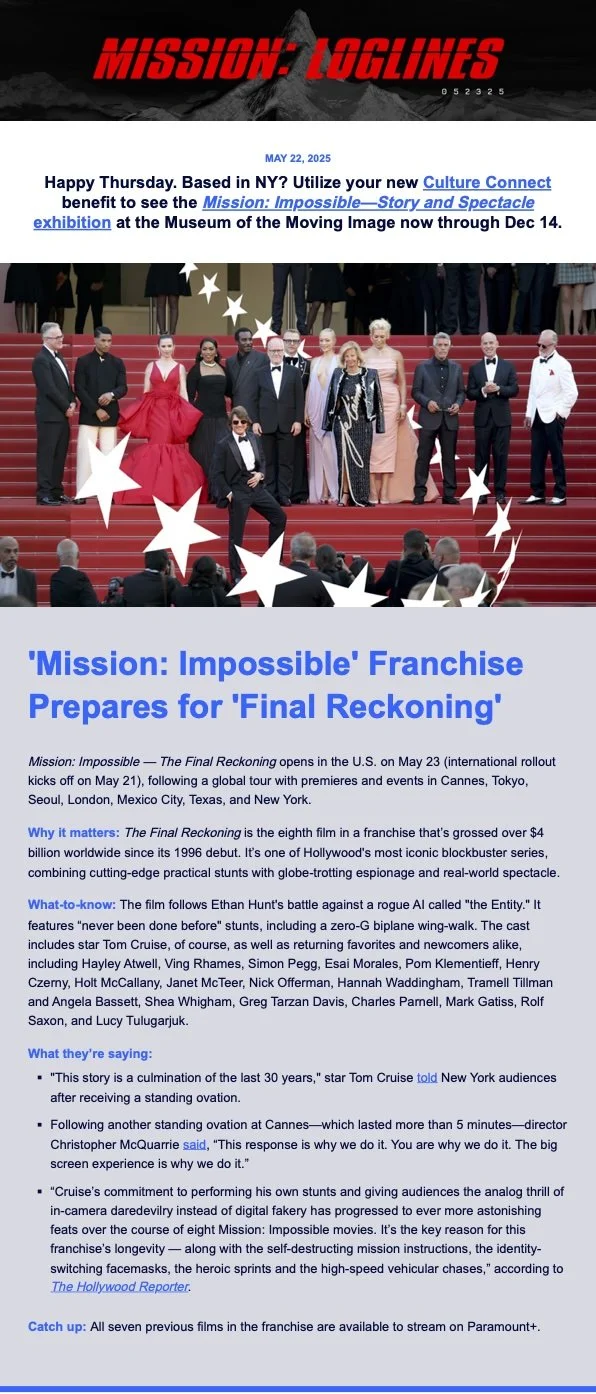
Loglines also became a vehicle for bringing the company's biggest moments to life internally. For tentpole franchises and major company events, we produced special editorial takeovers that transformed the newsletter's format, voice, and visual identity to match the subject.
Launching Loglines also forced a more sophisticated approach to internal communications infrastructure, including the adoption of internal communications software. That shift represented something larger than a tool change: it was the beginning of an internal marketing mindset at Paramount, treating employees as an audience with specific needs, behaviors, and preferences, and optimizing content to serve them with the same rigor we applied to external channels.
Impact
40% of employees read every issue and rated it their most informative communication channel.
50% average open rate — more than double the industry benchmark of 20-25%.
Integrated into Paramount's cross-platform content strategy as the internal distribution layer connecting the newsroom, social, and employee communications.
Explore the archive
A few of the best hits, in no particular order.
tk
tk
tk
tk